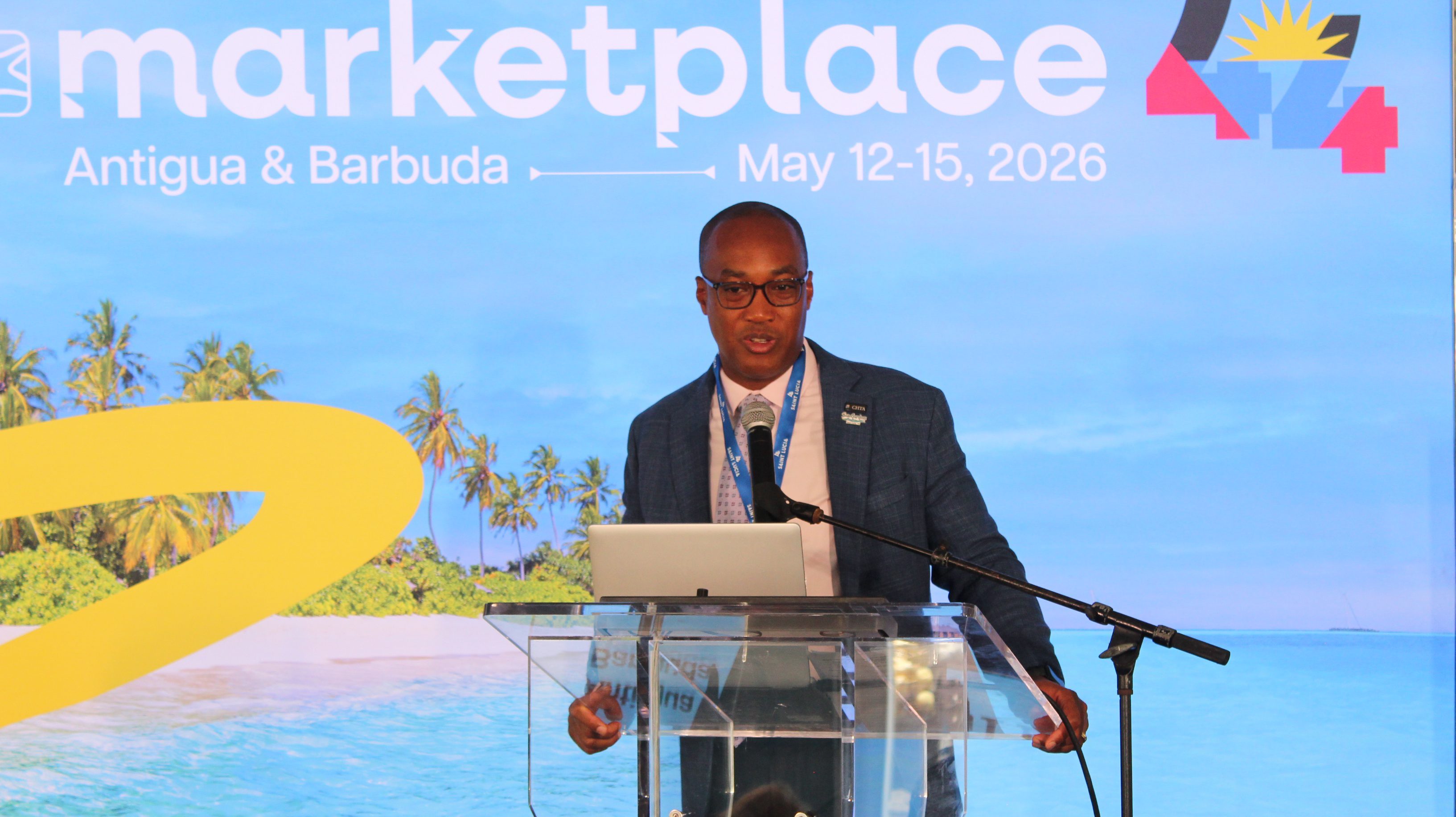
Caribbean Hotel and Tourism Association (CHTA) President Sanovnik Destang says regional tourism stakeholders are strongly opposing a planned change by Booking.com to how commissions are calculated for hotels in the region.
Speaking to the media during the Caribbean Travel Marketplace in Antigua on May 13, Destang said the Barbados Hotel and Tourism Association and tourism officials in Grenada recently alerted the CHTA to correspondence from Booking.com outlining the proposed changes.
According to Destang, the online travel company informed hotels that from May 15 it would begin calculating commissions not only on room rates and some service charges, but also on government taxes such as VAT and Government Service Tax (GST).
“So, typically, commissions are calculated on your room rate and in some countries the service charge and resort fee — so revenue, real revenue that you collect,” Destang said.
“They’re changing this now to also include VAT, GST and other government taxes, which, as you know, is not revenue to the hotel. It’s a pass-through.”
Destang said the CHTA has already met with Booking.com and strongly objected to the move.
“We have seriously advocated against this,” he said.
While Booking.com reportedly described the change as part of a wider global policy, Destang argued that the Caribbean’s tourism structure and legal systems differ from other regions.
“Our argument is that what exists globally may not necessarily exist in the Caribbean,” he said.
Destang said tourism stakeholders from at least five Caribbean destinations have already voiced opposition to the proposal, despite Booking.com only formally contacting two countries so far.
“So the whole region is saying absolutely no,” he said.
He explained that the proposed change would effectively force hotels to pay commissions on taxes collected on behalf of governments, increasing costs without providing any additional service to hotels.
Destang warned that the policy could result in millions of dollars leaving the Caribbean tourism sector annually.
He described the move as commercially unfair and said the CHTA is working to address the issue through legislation if necessary.
“We’re working with Ministers of Tourism and Ministers of Finance to ensure that they also pass legislation in their countries to effectively make it illegal,” he said.
Destang noted that Dominica already has legislation prohibiting commissions on VAT, sales tax and similar government charges.
He also criticised the way the policy was introduced, saying the decision was made without proper consultation with regional tourism stakeholders.
“Unfortunately, this one was done very unilaterally with no real notice or consultation of any sort,” he said.
Destang said the CHTA would continue to push back against the proposal to prevent similar policies from spreading across the online travel sector.
“We’ve drawn a line in the sand at CHTA,” he said.
“It’s not in the spirit of partnership.”
talk about the 10 dollars etc
Caribbean Hotel and Tourism Association (CHTA) President Sanovnik Destang says regional tourism stakeholders are strongly opposing a planned change by Booking.com to how commissions are calculated for hotels in the Caribbean.
Speaking to the media during the Caribbean Travel Marketplace in Antigua, Destang said the Barbados Hotel and Tourism Association and tourism officials in Grenada recently alerted the CHTA to correspondence from Booking.com outlining the proposed changes.
According to Destang, the online travel company informed hotels that from May 15 it would begin calculating commissions not only on room rates and some service charges, but also on government taxes such as VAT and GST.
“So, typically, commissions are calculated on your room rate and in some countries the service charge and resort fee — so revenue, real revenue that you collect,” Destang said.
“They’re changing this now to also include VAT, GST and other government taxes, which, as you know, is not revenue to the hotel. It’s a pass-through.”
Destang said tourism stakeholders from at least 5 or 6 Caribbean destinations have already voiced opposition to the proposal, despite Booking.com only formally contacting 2 countries so far.
“So the whole region is saying absolutely no,” he said.
Explaining the potential impact, Destang used the example of a hotel room costing $100 with a 10 per cent VAT charge.
He said if Booking.com charges a 20 per cent commission on the room rate, the hotel would normally pay $20 in commission. However, under the proposed system, the platform would also charge commission on the additional $10 VAT collected for the government.
“So you have to pay $2 more to Booking.com, and you still have to remit the $10 VAT to the government,” Destang said.
“In effect, it’s increasing the amount of revenue that they’re collecting depending on what the tax rate is in each island, between 10 per cent to 50 per cent, without having done anything additional to the service.”
Destang warned that while the additional amounts may appear small individually, the overall impact across the Caribbean tourism industry could be significant.
“It would be a leakage in tens of millions of dollars very easily for the Caribbean,” he said.
He described the move as commercially unfair and said the CHTA is working with tourism and finance ministers across the region to address the issue through legislation if necessary.
“We’re working with Ministers of Tourism and Ministers of Finance to ensure that they also pass legislation in their countries to effectively make it illegal,” he said.
Destang noted that Dominica already has legislation prohibiting commissions on VAT, sales tax and similar government charges.
He also criticised the way the policy was introduced, saying the decision was made without proper consultation with regional tourism stakeholders.
“Unfortunately, this one was done very unilaterally with no real notice or consultation of any sort,” he said.
Destang said the CHTA would continue to push back against the proposal to prevent similar policies from spreading across the online travel sector.
“We’ve drawn a line in the sand at CHTA,” he said. “It’s not in the spirit of partnership.”
Leave a Reply