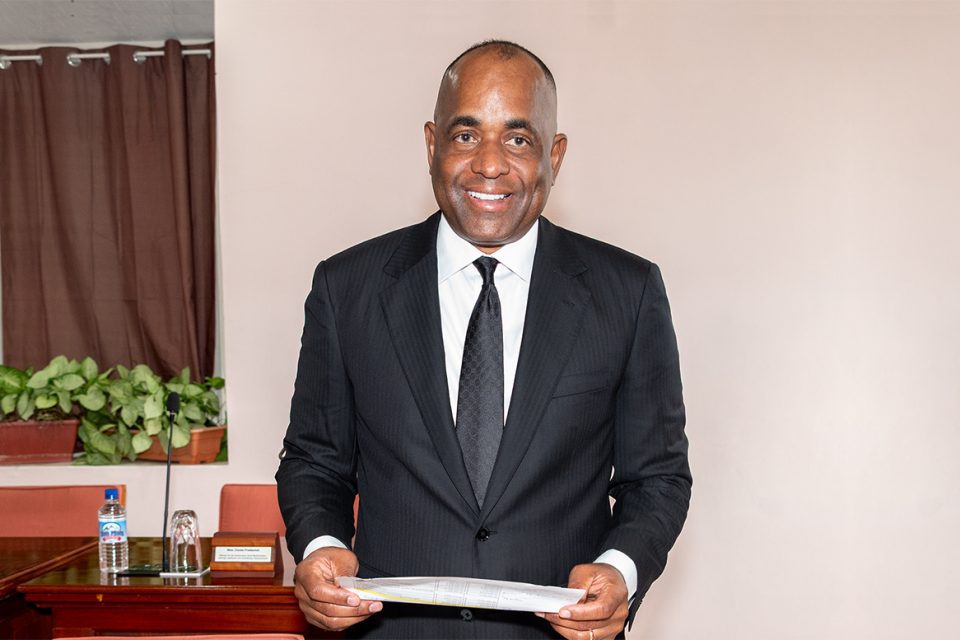
Prime Minister Roosevelt Skerrit has defended his Government’s fiscal management while outlining Dominica’s economic position in an address to Parliament on April 10.
His remarks followed the March Article IV report of the International Monetary Fund (IMF), which assessed the country’s recent economic performance.
Citing the report, Skerrit said real GDP growth accelerated to 4.5 per cent in 2025, up from 3.5 per cent in 2024, driven by strong tourism performance and sustained public investment.
He added that inflation has eased to 2.3 per cent, reflecting improving economic conditions.
While acknowledging that the current account deficit remains elevated, the prime minister said this is largely due to increased imports linked to major infrastructure and resilience projects, as well as investments in social safety net programmes.
He stressed that although these investments affect short-term fiscal balances, they are critical to Dominica’s long-term development.
Skerrit also sought to clarify the concept of the primary balance, which he said is often misunderstood in public discourse.
He explained that the primary balance measures the difference between government revenue and expenditure, excluding interest payments on debt, and is an important indicator of fiscal discipline and sustainability.
“For Dominica, this is especially important given our high public debt, our exposure to external shocks like natural disasters and global crises, and our dependence on imported goods and services,” he said.
The prime minister noted that following recent crises, including hurricanes, the COVID-19 pandemic and global inflation, Dominica recorded primary deficits averaging about 4.5 per cent of GDP.
However, he said the country has since returned to a primary surplus position through targeted fiscal consolidation efforts.
According to the IMF report, Dominica is currently recording a primary surplus of 0.7 per cent of GDP, equivalent to approximately $14.7 million.
Skerrit also addressed the IMF’s recommendation for the country to increase its primary surplus to 3.4 per cent of GDP over the medium term to strengthen fiscal resilience, reduce debt and build buffers against natural disasters.
However, he cautioned that achieving this target would require careful policy decisions and balancing competing priorities.
“Achieving and maintaining a healthy primary surplus requires careful policy choices, like raising revenue through additional taxation or improving tax compliance, controlling recurrent expenditure and prioritising capital investment,” he said.
“This creates policy tension between fiscal policy and the welfare of the human being,” he added.
Skerrit noted that measures such as VAT and duty waivers on essential goods are intended to ease the cost of living and protect citizens during periods of economic stress, but acknowledged that these also reduce government revenue.
“We are making steady progress in the responsible, sustainable, people-centred management of the nation’s finances. Maintaining this trajectory will require continued discipline, strategic prioritisation and a balanced approach that safeguards both economic stability and the welfare of our people,” the prime minister said.
Leave a Reply