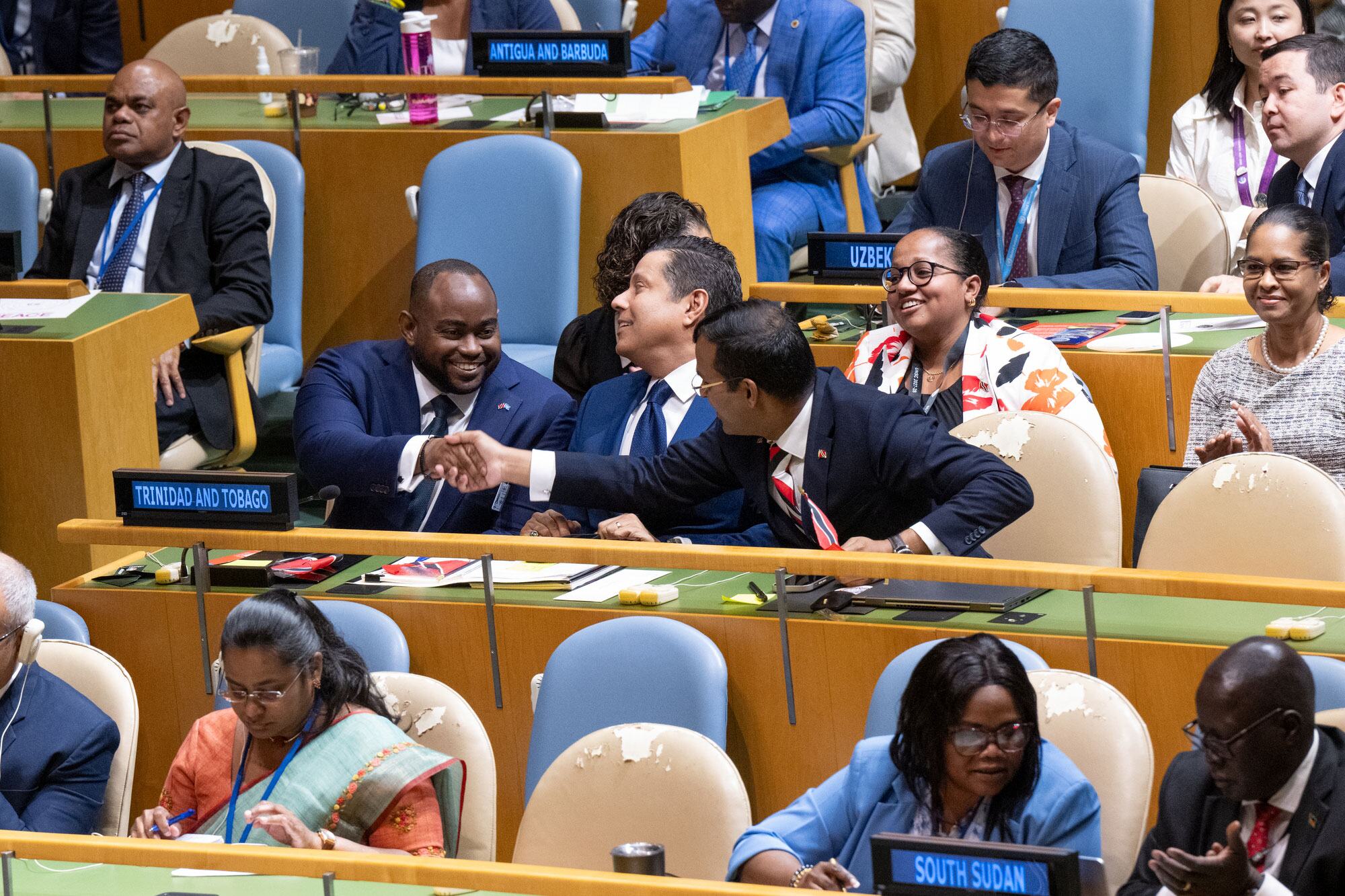
Trinidad and Tobago has been elected to a non-permanent seat on the United Nations Security Council for the 2027-2028 term after securing overwhelming support from member states during voting at the United Nations on June 3.
Representing the Latin American and Caribbean Group (GRULAC), Trinidad and Tobago received 181 votes from the 191 member states that participated in the election, equivalent to 95 per cent of votes cast.
The result comfortably surpassed the two-thirds majority required to win a seat on the 15-member council.
Trinidad and Tobago will replace Panama and will begin its two-year term on January 1, 2027, serving until December 31, 2028.
The country previously held a seat on the Security Council during the 1985-1986 and 2002-2003 terms.
Also elected to serve on the council were Austria, Kyrgyzstan, Portugal and Zimbabwe. Zimbabwe will replace Somalia, while Portugal and Austria will succeed Denmark and Greece respectively. Kyrgyzstan will replace Pakistan.
The Security Council is made up of 15 members, including five permanent members — China, France, Russia, United Kingdom and United States — which hold veto power, along with 10 non-permanent members elected for staggered two-year terms.
Following the vote, Minister of Foreign and CARICOM Affairs Sean Sobers thanked member states for their support.
“We wish to express our profound gratitude for the friendship, partnership and solidarity shown to Trinidad and Tobago during our campaign,” Sobers said.
He noted that Trinidad and Tobago’s campaign was built around “building consensus for the realisation of sustainable peace and security” and said that principle would guide the country’s work on the council.
Sobers said Trinidad and Tobago would focus on advancing the women, peace and security agenda, addressing the illicit trafficking of small arms and light weapons, and examining the implications of artificial intelligence for international peace and security.
He added that Prime Minister Kamla Persad-Bissessar had instructed the country’s representatives to use the Security Council seat to champion the concerns of all people, particularly those whose voices are often overlooked in international affairs.
“Today, we reaffirm our commitment to the UN Charter, international law and the rule of law,” Sobers said. “We pledge to foster dialogue and bridge differences amidst the multiplicity of complex challenges confronting the international community.”
Leave a Reply