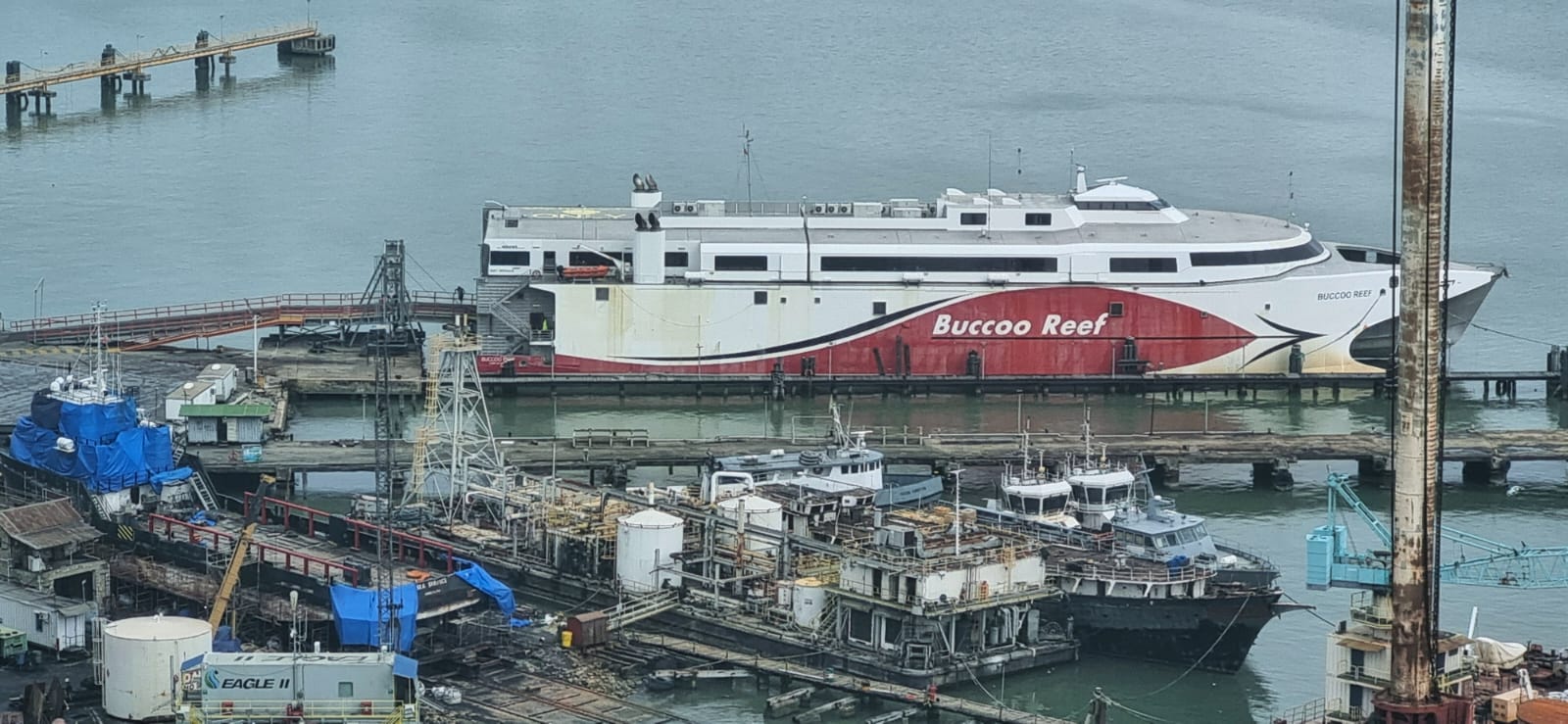
Caribbean leaders have agreed to use one of Trinidad and Tobago’s inter-island ferries as they move closer to launching a long-discussed regional ferry service aimed at lowering shipping costs and improving trade between Caribbean islands.
Barbados Prime Minister Mia Mottley announced the decision following talks with Trinidad and Tobago Prime Minister Kamla Persad-Bissessar and St Vincent and the Grenadines Prime Minister Dr Godwin Friday during the 51st CARICOM Heads of Government Meeting in St Lucia.
She said the vessel will be used as an interim measure while the private sector acquires ships for a permanent regional ferry service.
Trinidad and Tobago currently has five vessels for its domestic sea bridge.
They include the fast ferries Buccoo Reef, APT James and Trinidad Spirit, along with the Galleons Passage and the Blue Wave, the country’s only dedicated cargo vessel.
The Trinidad Spirit is currently out of active service.
Regional leaders have spent several years exploring the creation of a ferry network to improve the movement of passengers and cargo across the Caribbean, a longstanding objective of the CARICOM Single Market and Economy (CSME).
In 2024, officials announced plans for the Galleons Passage, a roll-on/roll-off catamaran capable of carrying about 400 passengers and 60 vehicles, to operate a route linking Trinidad and Tobago, Guyana and Barbados. While that service never materialised, the vessel has demonstrated its regional capabilities during humanitarian missions.
The ferry transported emergency relief supplies from Trinidad and Tobago to Grenada following Hurricane Beryl in 2024, delivered assistance to St Vincent and the Grenadines after the eruption of La Soufrière volcano, and was also used to repatriate Trinidad and Tobago nationals during regional emergencies.
Mottley said governments are now working to complete the legal and regulatory framework needed to support the service, including agreements covering the mutual recognition of driver’s licences, vehicle insurance and other operational requirements that would allow cargo vehicles to move between participating countries.
The initial phase is expected to focus on the southern and eastern Caribbean, although Mottley noted that some ports may require minor infrastructure upgrades or temporary ramps before the service can begin.
She said the initiative forms part of a broader effort to reduce the cost of moving goods around the region, lower the cost of living and strengthen regional trade.
“I give you the assurance that we are singularly focused on being able to reduce the cost of intra-island cargo, which in addition to the other measures that we have taken to increase disposable income of our citizens, but also to reduce the cost of freight, the cost of gas, and the cost of electricity, all of which, when combined, can be completely inflationary, is what we’re doing together. And none of us is omniscient. None of us has all the answers…So we will work together.”
“We are committed to shielding our population as far as possible,” Mottley said, noting that Caribbean countries continue to grapple with imported inflation and global economic uncertainty.

Leave a Reply