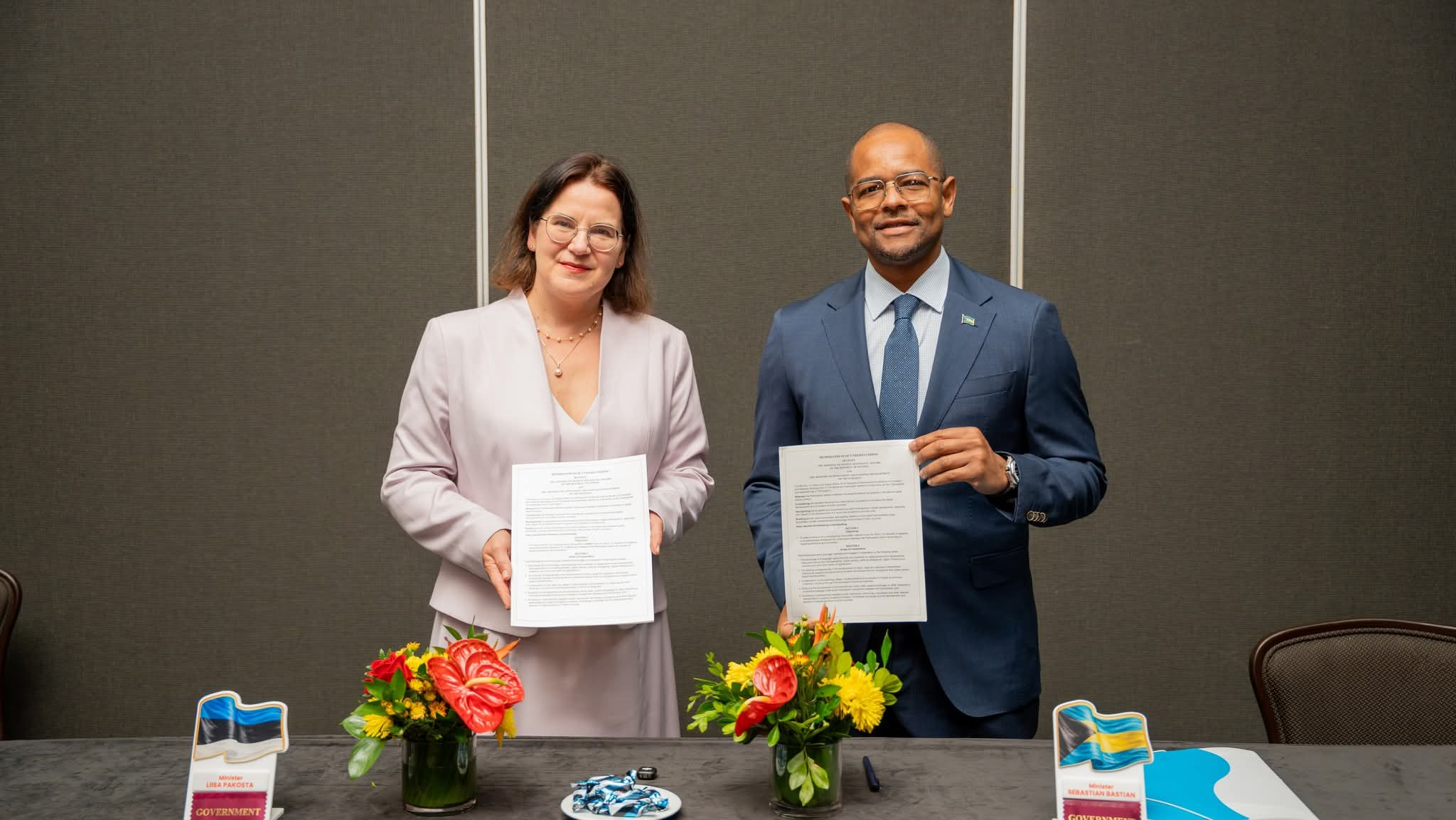
The Bahamas and Estonia have signed a Memorandum of Understanding (MOU) establishing a long-term partnership aimed at advancing digital transformation and innovation in The Bahamas.
The agreement was signed by Bahamian Minister of Innovation and National Development Sebastian Bastian and Estonia’s Minister of Justice and Digital Affairs Lilisa-Ly Pakosta on the margins of the 41st Annual CANTO Conference and Trade Exhibition in Punta Cana.
The MOU provides a framework for both countries to exchange knowledge, technical expertise and best practices in areas including digital government, interoperability, digital identity, artificial intelligence, cybersecurity, digital infrastructure, institutional capacity and citizen-centred public services.
It also provides for technical exchanges, study visits, workshops and partnerships involving governments, industry and technology stakeholders in both countries.
The agreement follows earlier discussions during the United Nations Global Dialogue on AI Governance in Switzerland, where Bastian met with Estonian officials to explore cooperation in artificial intelligence, digital government and government modernisation.
Estonia is recognised in the agreement as having extensive experience in digital government, including digital identity systems, interoperable frameworks and digital public services.
Bastian said the partnership provides The Bahamas with an opportunity to learn from Estonia’s experience while accelerating its own digital transformation efforts.
“Estonia has really been the model for e-governance in their advances in digital identity, interoperable frameworks and how modern governments work,” Bastian said.
He said working with a country that has already gone through the process would allow The Bahamas to benefit from its experience, including lessons from challenges it encountered along the way.
“Being able to draw on that technical support allows us to take out some of the guesswork and accelerate our efforts as we modernise government for the Bahamian people,” he said.
Bastian stressed that the partnership would not simply be about adopting new technology, but about building local capacity and ensuring Bahamians have ownership of the systems being developed.
“Success isn’t simply importing developers of AI, but being developers and builders,” he said. “Capacity building is what progress looks like and, most importantly, success looks like sovereignty.”
Pakosta said Estonia sees the partnership as an opportunity for both countries to learn from each other rather than a one-way exchange.
“Estonia is a small country and we believe globally there should be no digital divide and that every country must have the opportunity to benefit from digital transformation,” she said.
She said Estonia was prepared to share both its successes and its mistakes.
“We are very practical, results-oriented and open in our cooperation,” Pakosta said.
The Estonian minister said the partnership’s success would ultimately be measured by improvements experienced by Bahamian citizens and businesses.
“The success of this partnership will be when people feel that services are more efficient and better, when they feel they have opportunities,” she said.
She added that young Bahamians should be able to see a future for themselves in a digitally advanced country that creates new opportunities.
For The Bahamas, the partnership is intended to support the Ministry of Innovation and National Development’s efforts to modernise government, strengthen national capacity in emerging technologies and improve the country’s competitiveness in the global digital economy.
Bastian said the ministry’s goal was to ensure digital transformation translates into better public services and national competitiveness.
He also pointed to the speed at which the partnership moved from initial discussions to the signing of the MOU as evidence of the commitment of both countries.
The agreement forms part of the ministry’s broader international engagement strategy, which seeks to establish partnerships supporting government modernisation, responsible artificial intelligence, digital transformation and the development of future-ready skills for Bahamians.

Leave a Reply