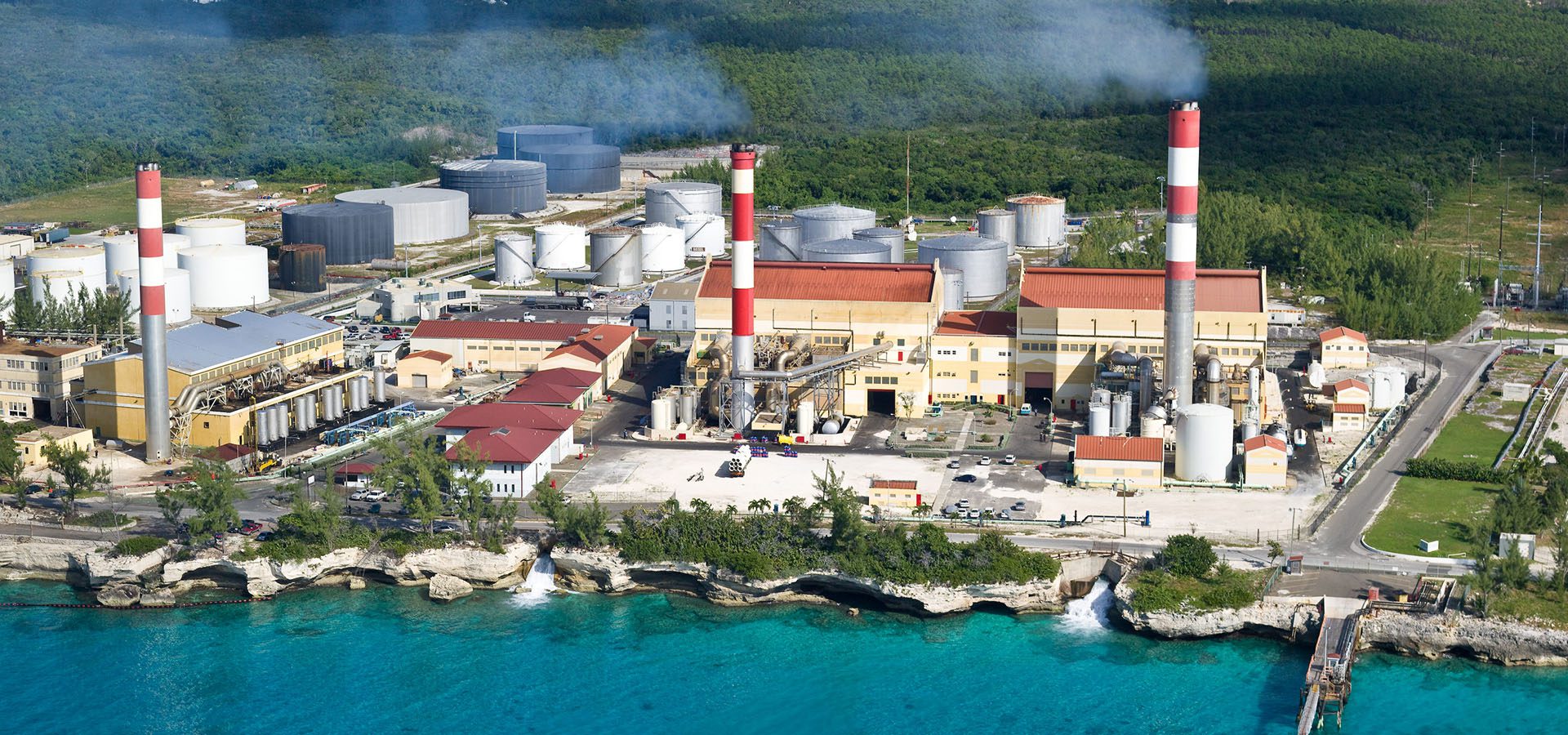
The Bahamas prime minister has outlined a major overhaul of the country’s electricity system as his government works to address years of underinvestment, aging infrastructure and a series of power disruptions that have affected residents in recent months.
In a national address on August 17, Prime Minister Philip Davis said the government was committed to transforming the country’s energy system rather than continuing to rely on temporary fixes.
The Bahamas has faced numerous electricity problems in recent months, including widespread outages and a major blackout on July 30 that left New Providence without power after a transformer failure at the Blue Hills substation.
Davis said the July outage was not caused by a shortage of generating capacity but by a failure in the transmission and distribution network.

“Adding more generation does not, by itself, keep your lights on,” Davis said, explaining that electricity generation and the infrastructure used to transmit and distribute power are separate but connected parts of the system.
The government says the electricity infrastructure it inherited is decades old and was not designed to support the country’s current population, economy or climate conditions.
Bahamas Power and Light (BPL) was carrying more than $500 million in debt, along with another $100 million in unfunded pension obligations, while engineers estimated that about $500 million was needed for critical upgrades.
More than 60 per cent of generation equipment in New Providence required replacement, according to the government, while the figure in the Family Islands was about 80 per cent.
Davis said BPL had also been spending more than $40 million annually to rent temporary generating equipment.
“We are not here to manage decline. We are not here to defend the status quo,” he said. “We are transforming the whole system — generation, fuel, transmission, distribution, metering, finance, and governance.”
Grid upgrades
The government has separated electricity generation from transmission and distribution, with Bahamas Grid Company (BGC) taking responsibility for New Providence’s transmission and distribution network.
Davis said BGC has delivered a $130 million foundational upgrade that includes stronger steel poles, larger conductors, modern protection devices, fibre communications, a looped transmission system and three new high-voltage substations.
The government says the work contributed to a 45 per cent reduction in outage frequency and a 35 per cent reduction in outage duration in 2025 compared with historical averages.
However, Davis acknowledged that recent outages show the system remains vulnerable.
“The lesson is not that the earlier work failed,” he said. “The lesson is that the upgrade is not yet complete, that reliability has not improved evenly in every community, and that an old and overstressed system can still lose ground when demand rises, or critical equipment fails.”
The government says additional generation capacity is now being restored, including Blue Hills GT2 and two Clifton Pier engines, while a Blue Hills turbine undergoing major inspection is expected to return in the first quarter of 2027.
The government also plans to begin phasing out 40 megawatts of rented generation in January as permanent capacity comes online.
Shift to natural gas and renewable energy
The government is also moving to diversify the country’s energy mix.
The first phase of liquefied natural gas is expected to come online this year, with the government targeting 190 megawatts of gas-fired generation capacity by late 2027.
Combined-cycle plants at Blue Hills are expected to be commissioned during 2027 and 2028.
At the same time, 23 solar and microgrid projects are being developed across the Family Islands, representing close to 200 megawatts of new generation.
Davis said the government also intends to expand battery storage and modernise the country’s metering system, allowing consumers to better monitor and manage electricity use.
The government plans to review the rules governing residential solar systems in consultation with the Utilities Regulation and Competition Authority, BPL, consumer groups and local solar installers.
The proposed changes include simpler applications, predictable approval times, wider access to two-way meters and compensation for excess electricity supplied to the grid.
BPL overtime concerns
Davis also addressed management and spending at BPL, revealing that the company spent approximately $20 million on overtime last year, despite transmission and distribution responsibilities now being handled by BGC.
He cited one case in which an employee reportedly claimed 90 hours of overtime over four consecutive days, including 18 hours on Christmas Day and 24 hours on each of the following three days.
The prime minister said a new overtime policy has been introduced, including a cap on planned overtime and mandatory reviews when technical workers’ overtime exceeds 30 per cent of their base salary.
He stressed that the measures were not directed at BPL’s wider workforce.
“The overwhelming majority of BPL’s workers are decent, skilled Bahamians who keep our lights on and go out in storms when the rest of us are told to stay inside,” Davis said.
“This is about a system that permitted this type of abuse.”
Davis said the government’s wider objective is to create a more reliable and affordable electricity system capable of supporting economic growth.
“This is the hardest infrastructure challenge our country has faced in fifty years of independence,” he said.
“It sat for decades because leaving it was easier. We took it on because you deserve a government prepared to do the difficult thing rather than the convenient one.”
The government acknowledged that further equipment failures and disruptions remain possible as the ageing system is upgraded, but Davis said the administration intends to complete the transformation rather than continue relying on short-term solutions.

Leave a Reply